
Key facts
- WHO Director-General Tedros Adhanom Ghebreyesus urged international partners to immediately reinforce support for Haiti.1
- Tedros said the population “cannot wait any longer,” and the meeting with Prime Minister Alix Didier Fils-Aimé examined Haiti’s strained health system.1
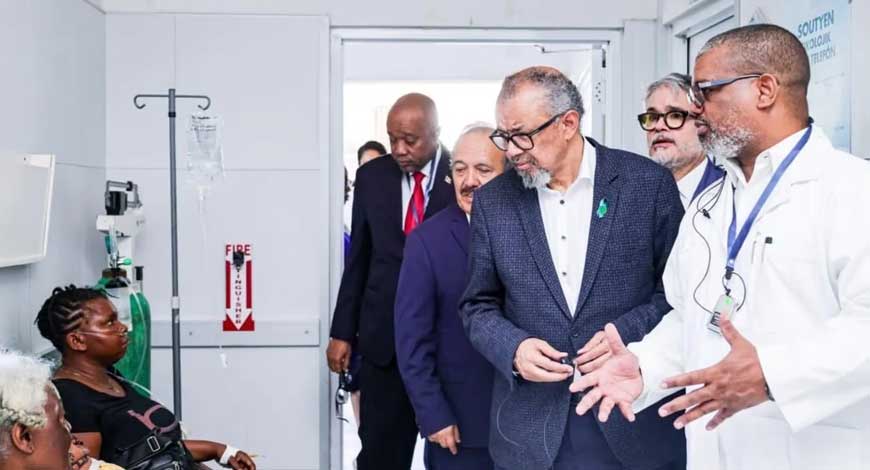
- WHO gave $1 million in medical equipment to Hôpital Universitaire La Paix, the last major public referral hospital in Port-au-Prince.2 3
WHO Director-General Tedros Adhanom Ghebreyesus has urged international partners to immediately reinforce their support for Haiti, where the humanitarian and security emergency continues to worsen.1
He emphasized that the population of the Caribbean country “cannot wait any longer.”1
A meeting with Haiti’s prime minister
The appeal came after a meeting held this Friday with Haitian Prime Minister Alix Didier Fils-Aimé, in which they analyzed the most pressing shortcomings of the country’s health system, which is under growing pressure from the upturn in violence and the deep crisis that Haiti is going through.1
Tedros regretted that Haiti continues to be left out of the attention of the international community and has highlighted the efforts of national authorities to sustain health services despite the serious lack of resources, especially in the areas of maternal and child health.1
“Haiti’s health system is under immense strain due to the overwhelming volume of patients and influx of trauma cases,” Dr Tedros said.1
$1 million to a Port-au-Prince hospital
WHO Director-General Dr Tedros Adhanom Ghebreyesus announced $1 million in support for critical medical equipment in Haiti.3
The funding will provide equipment to the overwhelmed Hôpital Universitaire La Paix (HUP) in Port-au-Prince, including a computed tomography (CT) scanner and equipment for four operating rooms..3 It is the last major public referral hospital still operating in the capital.3
A health system in crisis
Half (49.5%) of health facilities in Port-au-Prince are non-functional, and just 12% are partially operational, Medical Buyer said..3 Across Haiti, almost one quarter (24.5%) of health facilities are not functioning, and close to half (48.5%) are operating only partially.3
The growing number of internally displaced persons is 1.5 million to date, and an estimated 4.9 million people require health assistance in 2026.3
“I visited Hôpital Universitaire La Paix and saw firsthand the demands facing the facility and its staff. I also witnessed the resilience, courage and dedication of Haiti’s health workers amid the very challenging circumstances in which they are working,” Tedros said.1
WHO’s broader support for Haiti
In the last two years, WHO/PAHO has mobilized more than $30 million to support Haiti’s health response, with efforts ongoing to raise additional funds.3